We assess first
Most executives are not notable by Wikipedia's standards, and no amount of spend changes that. We will tell you before you spend anything. Roughly two-thirds of enquiries end here, and that is a good outcome.
Practice area 06
The structured-entity layer: what Google shows in the box beside your name, and what every AI assistant repeats when someone asks who you are. Handled within the rules, because the alternative is worse than having nothing.
Why this matters more than it did
A growing share of searches about a person never produce a click. The searcher reads a panel or an AI summary and moves on. Those surfaces are built from structured, independently sourced data — which means the question is no longer only what ranks, but what the machines believe.
Honest position
Most executives are not notable by Wikipedia's standards, and no amount of spend changes that. We will tell you before you spend anything. Roughly two-thirds of enquiries end here, and that is a good outcome.
Paid contribution without disclosure breaches the terms of use, and when it is discovered the article is deleted and the discovery itself becomes a search result. We use declared requests and talk pages only.
The route to an article is independent coverage in reliable publications, which is why this practice runs alongside earned media rather than instead of it. Sourcing first, article later.
Knowledge panels can be claimed, verified and corrected directly, and can often be improved even where no Wikipedia article exists. This is frequently the faster win.
Panels and AI answers pull from many structured sources. Getting them to agree with each other is unglamorous and it is most of the actual work.
Articles get vandalised, particularly during disputes and funding events. Monitoring catches it before it is mirrored across a hundred scraper sites.
Common questions
No. Notability is decided by volunteer editors against published criteria, and paid guarantees are a red flag. What we can do is assess honestly whether you meet the bar, build the independent sourcing that would support it, and make a properly declared request.
Usually, yes, and often within weeks. Panels can be claimed by the subject and correction requests submitted. Where the error comes from an upstream source, we fix the source — otherwise the correction reverts at the next refresh.
That is handled through Wikipedia's own dispute processes, with declared conflict of interest, not by reverting from an undisclosed account. Persistent bad-faith editing can be escalated to administrators, and for defamatory material there are legal routes as well.
Directly. Assistants lean heavily on Wikipedia, Wikidata and high-authority coverage. If those sources are thin, wrong or absent, the model fills the gap — sometimes plausibly and incorrectly. Fixing the sources is the only durable fix.
The structured layer
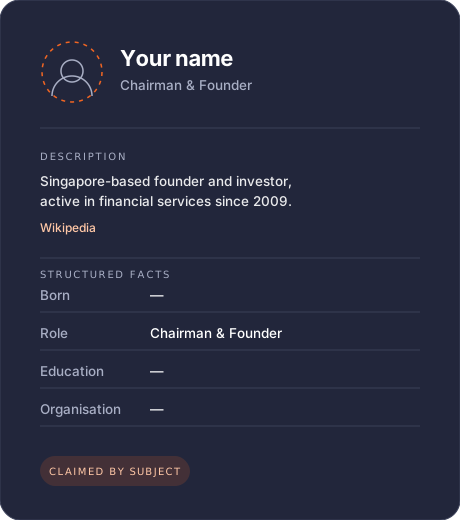
A knowledge panel is assembled from structured, independently sourced data. It can be claimed and corrected by the subject — which most executives never do, so the errors simply sit there.
Private enquiry
It is a short piece of work and it will often save you a great deal of money.